Parents are not just looking for another activity.
They are looking for ways to help their children focus, communicate clearly, build confidence, navigate social settings, recognize patterns, solve problems, persist through frustration, appreciate beauty, and grow into interesting humans with real hobbies and inner lives.
And they are trying to do all of that in the middle of work, school, dinner, laundry, and bedtime stories. Modern parenting is a lot. The pressure is not simply to keep children busy. It is to make wise decisions about the kind of person they are becoming.
That is one reason I think piano lessons deserve a second look; not as one more extracurricular, as résumé padding, or as a random enrichment extra, but as something much more useful than that.
Parents Are Looking for More Than Just an Extracurricular
Most parents are not sitting around thinking, My child needs more quarter notes. They are thinking things like:
How do I help my child focus?
How do I help them stick with something when it gets hard?
How do I help them become confident without becoming performative?
How do I give them healthy social experiences?
How do I expose them to something beautiful in a world that feels increasingly fast, loud, and shallow?
How do I help them become someone interesting?
These are the real challenges and problems parents face. And that is why piano is so powerful. Because in one well-designed lesson, a child can practice pattern recognition, communication, emotional regulation, self-management, listening, memory, timing, resilience, and artistic awareness all in one place. It doesn’t happen perfectly or magically. It does happen steadily one week at a time through play. That’s right, there’s a reason we call it “playing” the piano. Steady is what changes people.
Helping Children Build Focus, Confidence, and Resilience
I believe music is necessary because it helps make a person more whole.
Music trains attention in a distracted age. It preserves sensitivity in a world that often erodes it. Music strengthens the ability to perceive pattern, sequence, contrast, pacing, and emotional nuance. At the piano, students are constantly learning to hear relationships, organize movement, decode symbols, and shape something meaningful over time.
In other words, piano is not just about learning notes. Playing the piano is about learning how to attend- and that matters.
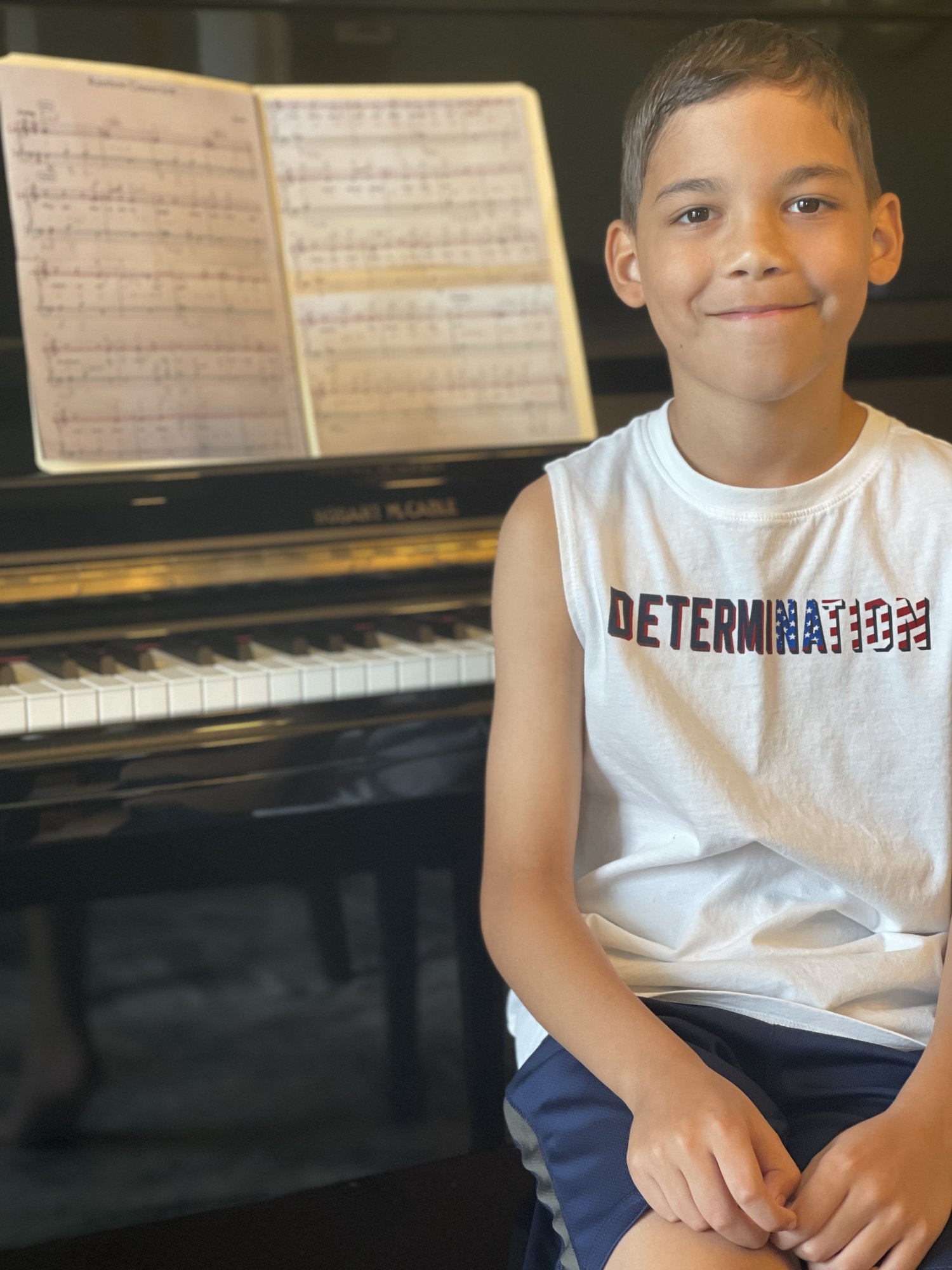
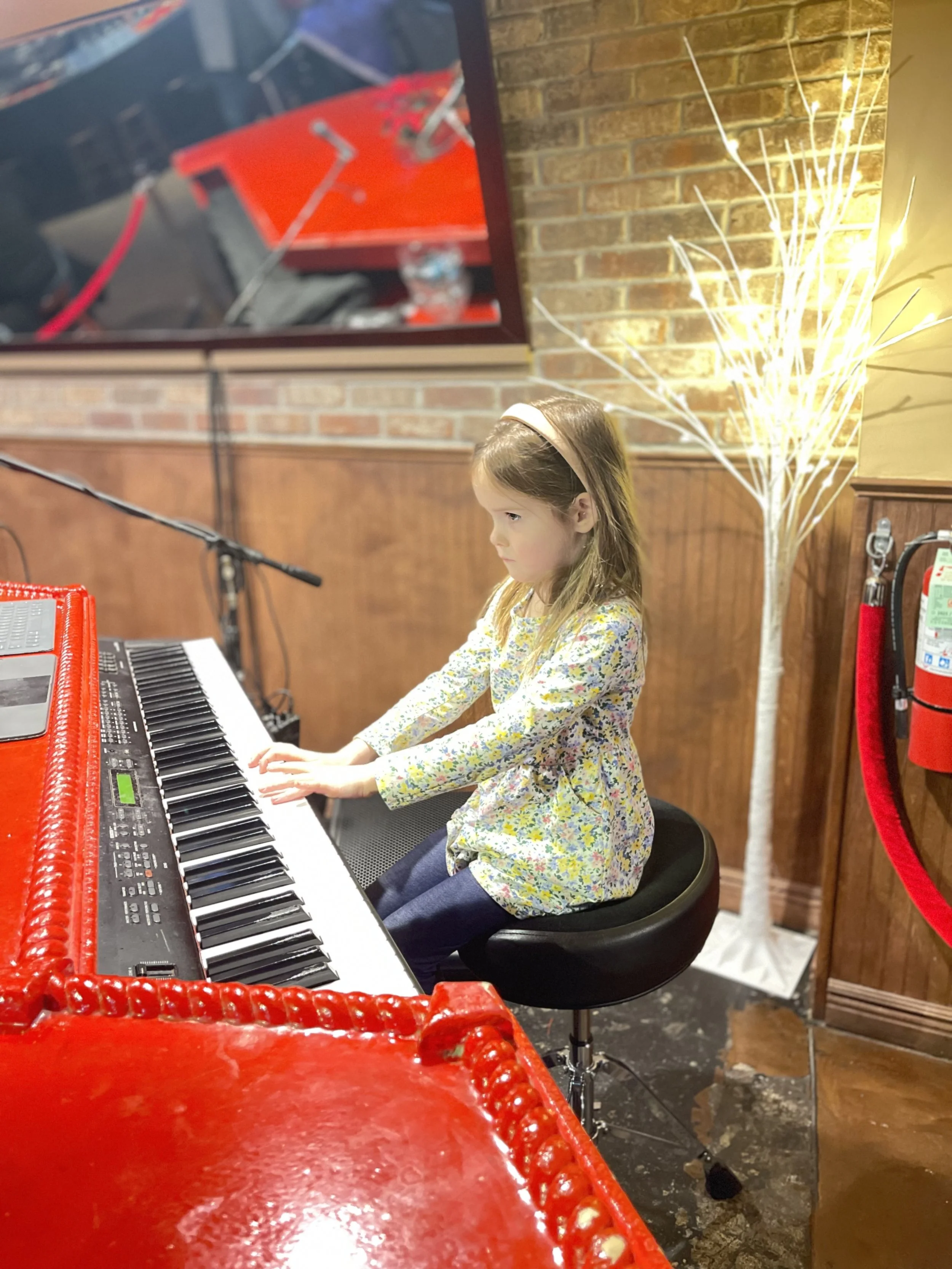
For children, music can help build focus, patience, self-regulation, confidence, delight, and play.
For adults, it can be a way back to presence, back to discipline with soul, back to a part of themselves that is awake, expressive, and deeply alive. Sitting at the piano to play can be a restorative place to shake the dust off of life.
Music is not fluff. It is not merely decorative. It is not just a cute extra if you happen to have the time. Music helps form the inner architecture of a person.
That is why it matters.
What Piano Lessons Actually Teach
People often assume piano lessons are mainly about songs, recitals, and maybe a little discipline.
But good piano study is doing much more than that.
A child learning piano is learning to:
notice patterns
predict what comes next
coordinate both sides of the body
decode symbols
listen for detail
take turns in a social setting
respond to feedback
persist through mistakes
tolerate frustration
communicate musically and verbally
develop taste
build a relationship with art
That is an enormous amount of human development in one little half-hour.
And importantly, it is development that does not always feel like work in the deadening sense. In the Piano Playground (children) and the Key Club (adults) it more often feels playful, social, beautiful, satisfying, and fun.
That is part of the genius of it.
If only there were one place where a child could practice pattern recognition, sequencing, listening, communication, collaboration, persistence, artistic expression, and cultural fluency in one 30-minute session a week.
In many ways, that is exactly what Obbligato Music aims to deliver, not because we want playing the piano to replace everything else; but because it develops capacities that support everything else.
Why This Matters for Arlington Families
Arlington families tend to care deeply about education, opportunity, developmental fit, and how children spend their time. That matters, because it reflects something many parents here already sense: children need more than academic output. Children need experiences that build the person, not just the transcript.
Piano fits beautifully into that value system. It is rigorous without being sterile. It is expressive without being chaotic. It supports cognitive growth, emotional maturity, communication, and cultural literacy all at once.
For busy Arlington families, that matters. When one activity carries this much developmental weight, it stops being just another extracurricular. It becomes leverage. It becomes one of the rare places where many good things can happen at once.
A Necessary Luxury
I think piano lessons are a necessary luxury. A necessary luxury is something beautiful that also does real work. It is not survival in the narrowest sense. It is not food, water, or shelter. But it makes life more livable, more humane, more ordered, and more meaningful. It improves not just comfort, but quality of being.
That is how I think about music.
Music brings beauty, yes. It also builds discipline, attention, sensitivity, coordination, memory, and expressive capacity. It gives children a place to encounter structure and freedom at the same time. It teaches refinement without demanding hardness. It creates a place where expression and order meet.
That is not fluff. That is formation. Children do not only need optimization. They need beauty. They need ritual. They need culture. They need depth. They need a chance to care about something beyond immediate entertainment. Music offers that. So yes, I think piano is a necessary luxury.
It is luxurious because it brings beauty, refinement, pleasure, and culture into ordinary life.
It is necessary because it helps build the very capacities modern families are desperate to cultivate: focus, communication, resilience, discernment, confidence, and the ability to engage meaningfully with the world.
How to Begin at Home
If you’d like to begin at home, I share a monthly playlist and a simple game in the Obbligato Music Notes newsletter to help children interact with music in a playful, low-pressure way. It is a gentle way to start building listening, rhythm, attention, and delight into family life before music ever becomes another item on the calendar.
And if you want to make that play feel a little richer, a couple of simple tools can help. A good Bluetooth speaker makes it easier to bring music into everyday family life, whether that means a dance break in the kitchen, a listening moment before bed, or a few minutes of rhythm play after school. I love the UE Boom from Ultimate Ears. The sound is unbelievably rich and clear. A small basket of rhythm instruments — things like shakers, rhythm sticks, scarves, or a hand drum — gives children a hands-on way to respond to beat, tempo, mood, and pattern.
Before piano lessons ever begin, music can become a presence in the home.
Final Thoughts
That is why I do not see piano as an extra.
I see it as one of the smartest, most efficient, and most humanizing investments a family can make. Not every child needs to become a concert pianist. But because every child benefits from learning how to listen, how to focus, how to persist, how to communicate, how to contribute to an community, and how to make something beautiful with their own hands.
Piano will not do all of that alone. But it can do much more than people think. And that is exactly what makes it worth protecting.
This post may contain affiliate links. That means I may earn a small commission, at no extra cost to you, if you choose to purchase through them. I only recommend products I genuinely trust and would feel comfortable using in my own studio or recommending to Obbligato families.