
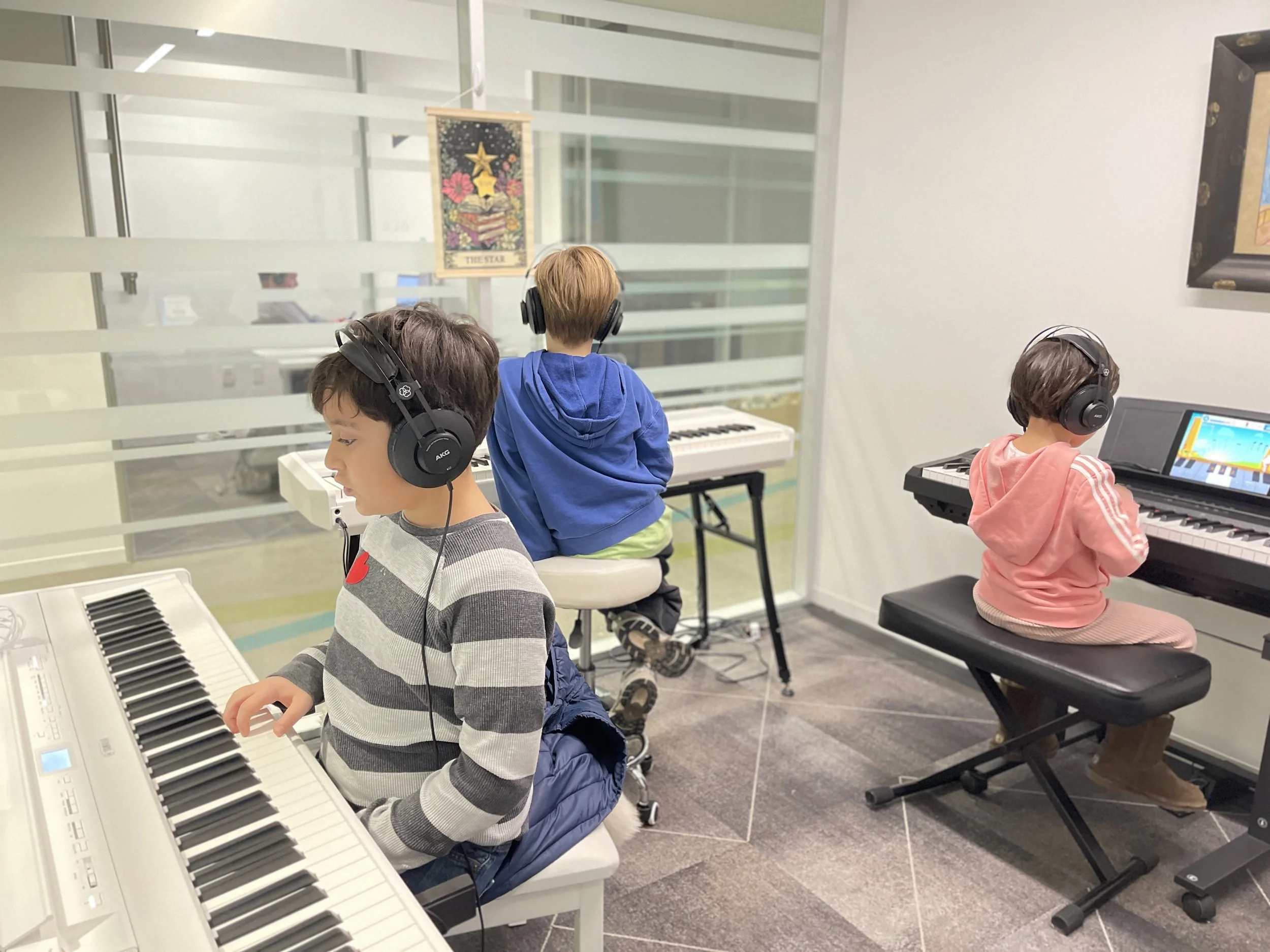
Semi-private students at Obbligato Music practicing on Yamaha P-525 and Yamaha p-71 digital pianos.
How to Choose the Right Beginner Keyboard (For Kids & Adults)
If you’re thinking about starting piano — for your child or for yourself — the first practical question is usually:
What should we buy?
There are hundreds of options. Some look like toys. Some look like furniture. Some promise features you’ll never use.
Choosing well matters — not because you need the most expensive instrument, but because the right instrument supports growth from the very beginning.
Before we talk models, let’s talk about why this matters.
This post contains affiliate links. If you choose to purchase through these links, I may earn a small commission at no additional cost to you. I only recommend instruments I use myself or trust for long-term musical development.
Why Music Is Necessary (And Why Piano Is Different)
One of the most underestimated skills in modern life is pattern recognition — the ability to see structure, anticipate what comes next, and make sense of complexity.
Piano develops this quietly and beautifully.
When a student learns a piece, they are not just pressing keys. They are learning to:
Recognize rhythmic repetition
Notice how certain notes resolve into others
Track visual patterns on the page
Map those patterns onto physical space
Predict what a phrase should sound like before playing it
Reading. Listening. Coordinating. Anticipating.
All at once.
Few activities layer symbolic systems and physical coordination this densely in real time.
For children, this builds comfort with structured thinking.
For adults, it strengthens cognitive flexibility and sustained attention.
The instrument becomes more than an instrument.
It becomes a structured environment for growth.
So let’s choose one that supports that work.
What Actually Matters in a Beginner Keyboard
If you remember nothing else, remember this:
1. 88 Full-Size Keys
Students grow into the full range. Starting with fewer keys often means upgrading sooner.
But there’s another reason this matters — and it’s rarely mentioned.
We develop muscle memory around geography.
On a full 88-key instrument, middle C is actually near the center of the keyboard. The visual and physical layout is balanced. As students learn intervals, hand shapes, and spatial relationships, their bodies internalize where things “live.”
On a 61-key keyboard, middle C is no longer centered. The proportions shift. The geography changes.
It may seem minor, but over time it affects how students orient themselves physically on the instrument. When they eventually move to a full piano, everything feels slightly displaced.
For early development, consistency in layout supports consistency in technique.
If at all possible, start with the full 88 keys.
2. Weighted or Hammer-Action Keys
This develops control, tone, and finger strength properly. Without it, technique suffers.
3. Pedal Compatibility
Even beginners benefit from understanding sustain and connection.
Everything else — extra sounds, flashy lights, novelty features — is secondary.
My Recommended Beginner Digital Pianos
I prefer a short, curated list over overwhelming you with ten nearly identical options.
These are instruments I either use myself or trust based on long-term experience.
Entry-Level Option (If Budget Is the Limiting Factor)
Donner DEP-20
88 weighted keys
Sustain pedal included
Accessible price point
I use this model in one of my teaching locations because it is lightweight and practical for a flexible studio setup.
It does not feel as refined as Yamaha’s action. But if the choice is waiting indefinitely or beginning now, this is absolutely better than not starting.
Best for:
Families testing long-term interest
Younger beginners
Budget-conscious households
Best Yamaha Entry-Level Option (My Preferred Starting Point)
Yamaha P-71
88 weighted keys
Yamaha GrandTouch-S™ action (derived from Yamaha grand pianos)
Rich, resonant tone
Bluetooth connectivity for apps and recording
If budget allows, this is where I typically guide families.
The key response feels more stable. The tone is more balanced. And students tend to stay satisfied with this instrument longer.
For most beginners, this is the sweet spot between price and performance.
Best Long-Term Investment
Yamaha P-525
Wooden keys for a more acoustic-like feel
Rich, resonant tone
Bluetooth connectivity for apps and recording
This is where the experience shifts.
Most digital pianos at this price point use plastic key construction. Plastic works — but it often produces a subtle mechanical click and a lighter rebound that reminds you you’re playing electronics.
The P-525 uses real wooden keys paired with Yamaha’s GrandTouch-S action, derived from the same engineering principles used in Yamaha grand pianos.
Why does that matter?
Because technique is built on resistance.
The weight of the key, the length of the pivot, the graded heaviness from bass to treble — these are not cosmetic details. They train the hand to:
Control depth of attack
Shape dynamics
Develop finger independence
Manage arm weight properly
Wood absorbs vibration differently than plastic. The downward motion feels grounded. The return feels more natural. And you avoid much of the surface clicking that lighter plastic actions can produce.
For students preparing eventually to play acoustic pianos — whether in lessons, recitals, or exams — this kind of action is invaluable.
And here’s the remarkable part:
Wooden key construction and grand-derived hammer mechanisms are typically found on instruments that cost two to four times as much. At this price tier, it’s rare — especially in a portable-style digital piano.
Add to that Bluetooth connectivity for:
Connecting to learning apps
Streaming backing tracks
Recording audio directly into video
…and it becomes both musically serious and practically modern.
Best for:
Dedicated students
Adult musicians
Families building a long-term musical home
Students transitioning toward acoustic piano
When Space Is the Priority
In many Arlington homes — especially townhouses, condos, and shared family spaces — square footage is at a premium.
And if your city is anything like Arlington, you may not have a dedicated music room waiting for a full-size upright piano.
Sometimes the instrument needs to live in a bedroom, along a living room wall, or in a multi-use space without taking over the room.
In those situations, cabinet-style digital pianos with sliding key covers can be a practical solution. When closed, they function more like a console or desk. When open, they’re ready for practice.
If you explore this category, prioritize:
88 full-size keys
Weighted or hammer-action keys
Key feel and tone quality can vary significantly among budget cabinet models, so if possible, try one in person before purchasing.
In my experience, the best instrument is the one that fits realistically into your daily life — not the one that disrupts it.
Final Thoughts
The goal is not to buy the most impressive instrument.
The goal is to choose something that supports consistency.
A beautiful piano that never gets played is less valuable than a modest one used daily.
If you’d like to see my full curated list of recommended instruments and accessories, you can visit my Piano Recommendations page here.
(Insert internal link.)
And if you’re local to Arlington, I offer semi-private piano sessions for children through Piano Playground and boutique small-group lessons for adults through Key Club.
Schedule a complimentary session here.
Music lasts.
Choose something that makes beginning feel possible — and continuing feel natural.
This post contains affiliate links. If you choose to purchase through these links, I may earn a small commission at no additional cost to you. I only recommend instruments I use myself or trust for long-term musical development.