
Could the answer be that easy?
By the time school lets out, many kids are not exactly arriving at their most polished, cooperative, tiny-scholar selves.
They are hungry.
They are tired.
They are full of words.
They have been sitting, listening, waiting, sharing, lining up, transitioning, and holding themselves together for hours.
So when a parent wonders whether piano lessons are “too much” after school, I understand the question.
But here is the surprising thing:
The right kind of piano lesson does not always add more pressure.
Sometimes it gives a child a place to finally exhale.
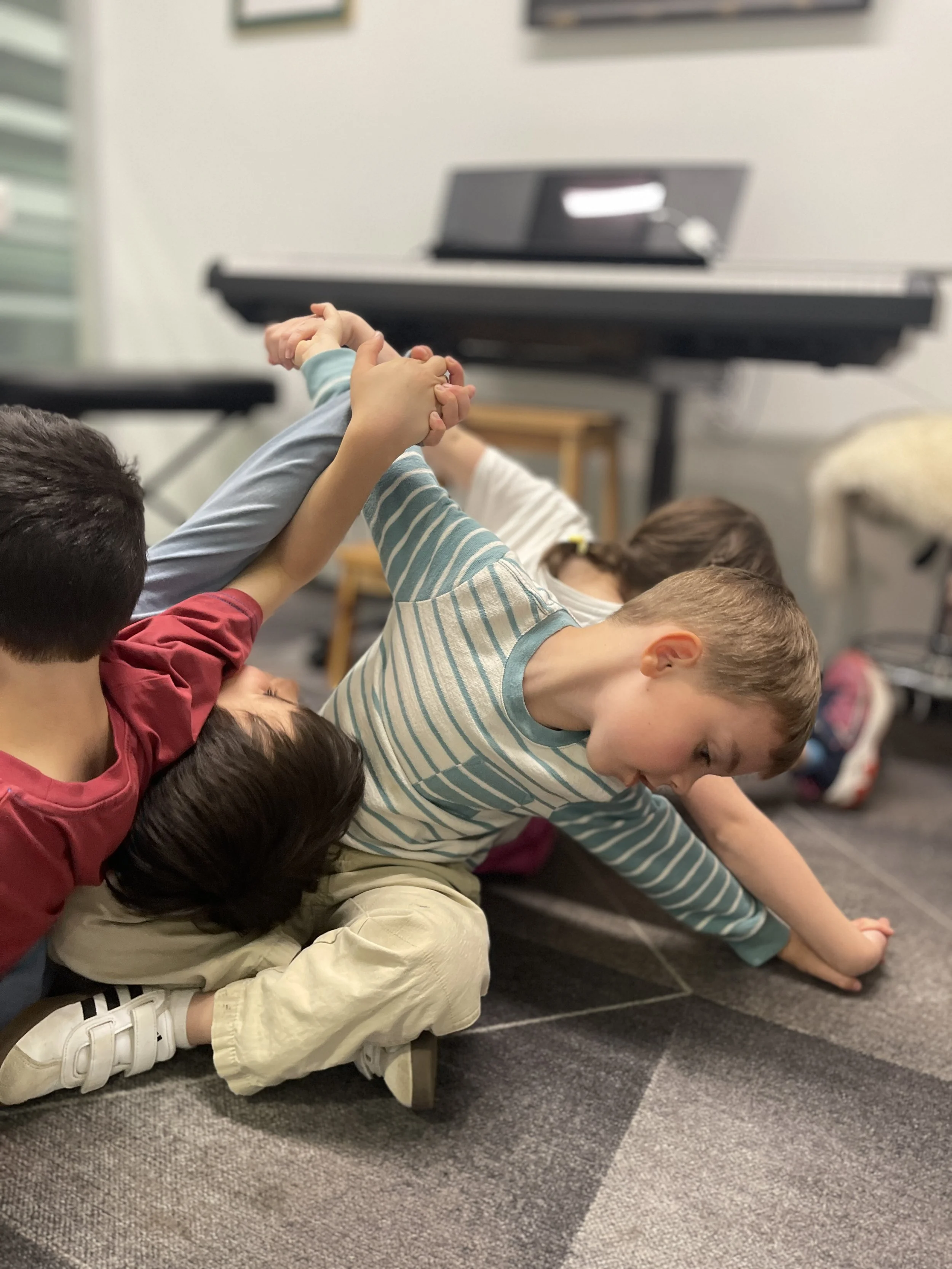
At Obbligato Music, we think about piano lessons as more than one more activity on the calendar. Especially in Piano Playground, our semi-private piano program for kids, the piano becomes a place where children can move, listen, focus, try again, laugh, and settle.
Not perfectly.
Not silently.
Not like little conservatory robots in cardigans.
But in a way that helps them come back to themselves.
Why After-School Piano Can Work So Well
After school, children often need a transition.
They do not necessarily need to be told to “calm down.” They may not even know how. They need something that helps their nervous system shift gears.
Piano can do that beautifully because it gives the body and mind something clear to organize around.
A steady beat.
A pattern.
A phrase.
A sound they made themselves.
A small goal they can actually complete.
Instead of demanding instant focus, piano invites focus.
A child sits down, finds two black keys, plays a rhythm, listens for the sound, tries it again, and suddenly their attention has somewhere to go.
That is very different from being told to “pay attention.”
It is attention built through experience.
Music Gives Big Energy Somewhere Beautiful to Go
Some children come into lessons quiet and shy.
Some arrive like golden retrievers who just discovered espresso.
Both are welcome.
One of the reasons music is necessary is that it gives children a structured place for energy. They can tap, clap, sway, count, sing, press, listen, and respond. They can use their whole body, but with purpose.
At the piano, movement is not random. It becomes rhythm.
Sound is not noise. It becomes music.
Trying again is not failure. It becomes practice.
That matters because children are not just learning songs. They are learning how to organize themselves.
They are learning how to begin, pause, listen, adjust, and keep going.
Those are piano skills, yes.
But they are also life skills.
Why We Use Movement Before and After Piano
In Piano Playground, we often use simple movement tools to help children transition into and out of playing.
This is not extra fluff.
A child’s hands do not operate in isolation. The back, spine, feet, shoulders, breath, and attention all matter. When children move first, they often sit at the piano with more ease.
They are less stiff.
They are less grabby.
They are more awake.
They are more ready to listen.
Before piano, movement helps them arrive.
After piano, movement helps them release.
That rhythm — arrive, focus, play, release — is part of what makes a lesson feel good instead of forced.
A Few Helpful Tools for an After-School Piano Reset
As an Amazon Associate, I earn from qualifying purchases. Some links in this post may be affiliate links, which means I may receive a small commission at no extra cost to you.