
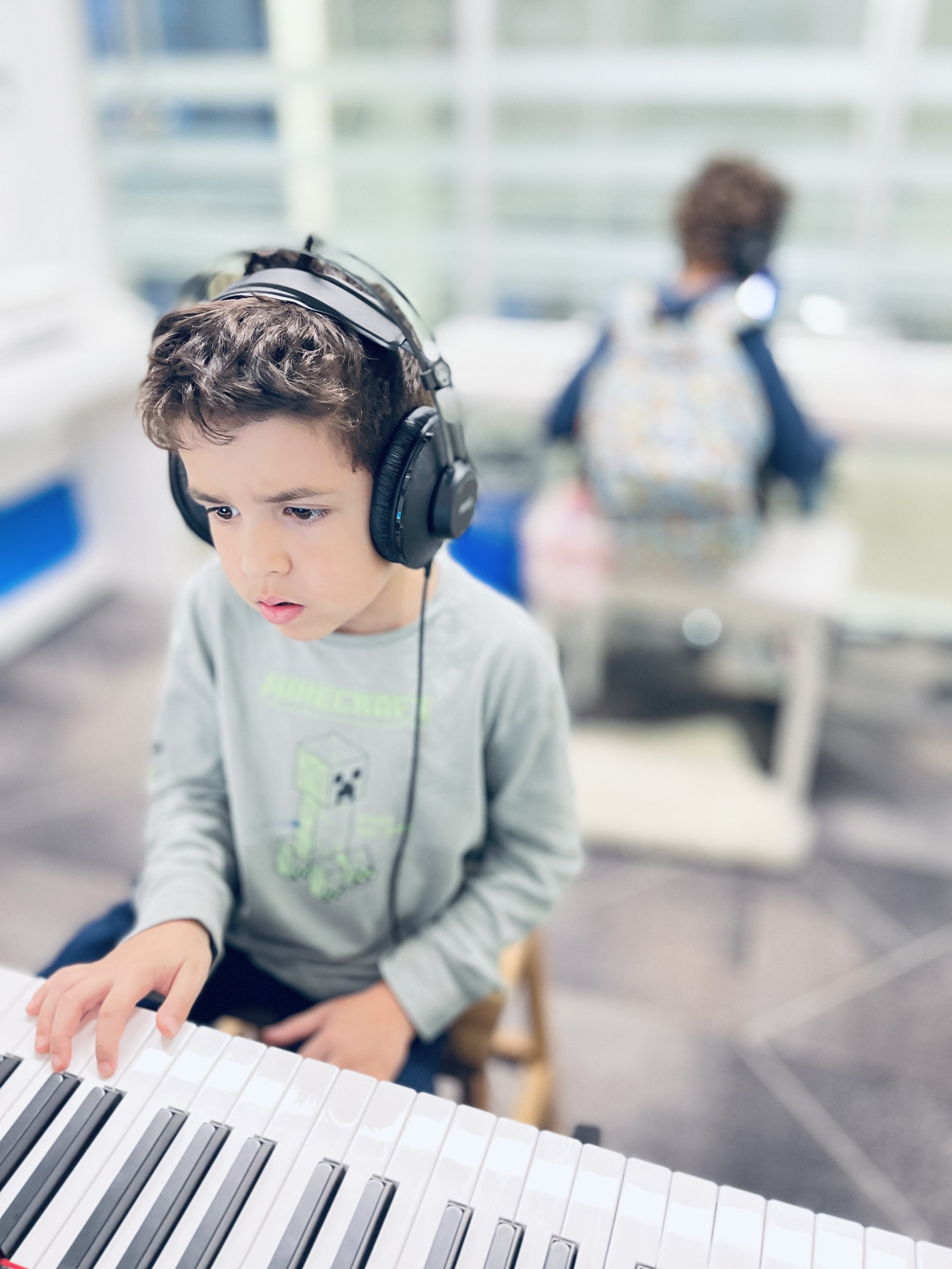
Child concentrating during piano lesson at Obbligato Music atelier in Arlington VA
When Attention Has Nowhere to Land: Piano Lessons for Children with ADHD
This post may contain affiliate links. As an Amazon Associate, I earn from qualifying purchases at no additional cost to you. I only recommend tools we genuinely trust or thoughtfully suggest to families.
If you’re parenting a child with ADHD, you’ve likely heard a lot of advice.
More structure.
More movement.
More routine.
Less screen time.
More patience (from you, of course).
But here’s something you might not have considered:
Piano lessons.
Not as résumé padding.
Not as performance pressure.
But as regulation.
ADHD Is Not a Deficit of Intelligence — It’s a Regulation Challenge
Children with ADHD often struggle with:
• sustained attention
• impulse control
• emotional regulation
• executive function
What they don’t struggle with? Creativity. Energy. Intuition. Big feelings.
The real question becomes:
Where does all that awareness go?
Piano gives it somewhere to land.
The Deeper Reason Music Is Necessary
ADHD is often described as a deficit of attention.
But what if it’s actually a surplus of awareness — without structure?
Music provides structure inside time.
When a child plays piano, they are required to:
• remember what just happened
• process what is happening
• anticipate what comes next
All at the same time.
Very few activities train this three-part awareness.
Music does.
This is why music is not enrichment.
It is temporal training.
It teaches the brain how to live inside time — instead of being chased by it.
For a child who feels constantly pulled forward by impulse, music creates a gentle discipline:
Wait.
Listen.
Then move.
That skill extends far beyond the piano bench. It’s just one of the reasons Music is Necessary.
Why Piano Works (When Other Activities Don’t)
In our Arlington Piano Playground sessions, we design lessons specifically for developing brains.
During a piano lesson:
• both hemispheres of the brain fire simultaneously
• rhythm regulates breathing and heart rate
• pattern recognition strengthens executive function
• fine motor control integrates with auditory processing
And perhaps most importantly:
The child experiences focused success.
Not chaos.
Not correction.
Not comparison.
Focused success.
Supporting Dynamic Balance at the Piano
This year in our studio, we’re paying special attention to healthy coordination and whole-body awareness — principles drawn from the F. Matthias Alexander.
For many children (especially those with ADHD), focus improves when the body is allowed subtle, organized movement rather than forced stillness.
Two simple tools some families experiment with at home:
1. A Discreet Wobble Cushion
A balance disc placed on the piano bench allows micro-movements through the hips while maintaining upright posture.
It gives the nervous system gentle input without turning practice into chaos.
A simple option like the Gaiam Balance Disc Wobble Cushion works well because it’s stable, durable, and not visually distracting.
→ [Gaiam Balance Disc on Amazon]
Stillness is not the goal.
Organized movement is.
2. A Foot Resistance Band
Some children regulate more easily when their feet have feedback.
A large loop resistance band wrapped around the piano bench legs allows the child to press gently with their feet while playing. That pressure can increase grounding and reduce fidgeting through the hands.
Simple heavy-duty loop bands like the Fit Simplify Resistance Loop Exercise Bands can work well for this purpose.
→ [Resistance Loop Bands on Amazon]
The goal is not to restrain movement.
It’s to give it a constructive direction.
When the body feels supported, attention follows.
Structure Without Shame
Traditional environments can be exhausting for children with ADHD. They are constantly being redirected.
In piano, structure is built into the music itself.
A rhythm repeats.
A pattern returns.
A phrase resolves.
The structure lives inside the art.
Children learn to anticipate.
They learn to wait.
They learn to listen.
And because piano is tactile and auditory, it engages the body — not just the mind.
Is Piano a Cure for ADHD?
No.
But it can be a powerful support.
We’ve seen students become more patient.
More confident.
More capable of finishing what they start.
Those are not small skills.
They carry into math, reading, and daily life.
Music is not a luxury activity.
It is neurological integration disguised as art.
If you’re in Arlington or Potomac Shores and wondering whether piano could support your child, we’d love to explore it with you.
Because sometimes the solution you’re looking for doesn’t look like a solution at all.
It looks like a piano.
Would your child benefit from this kind of grounded attention? The next question is often about timing. We’ve written more about developmental readiness in our post on what age a child should start piano lessons.