
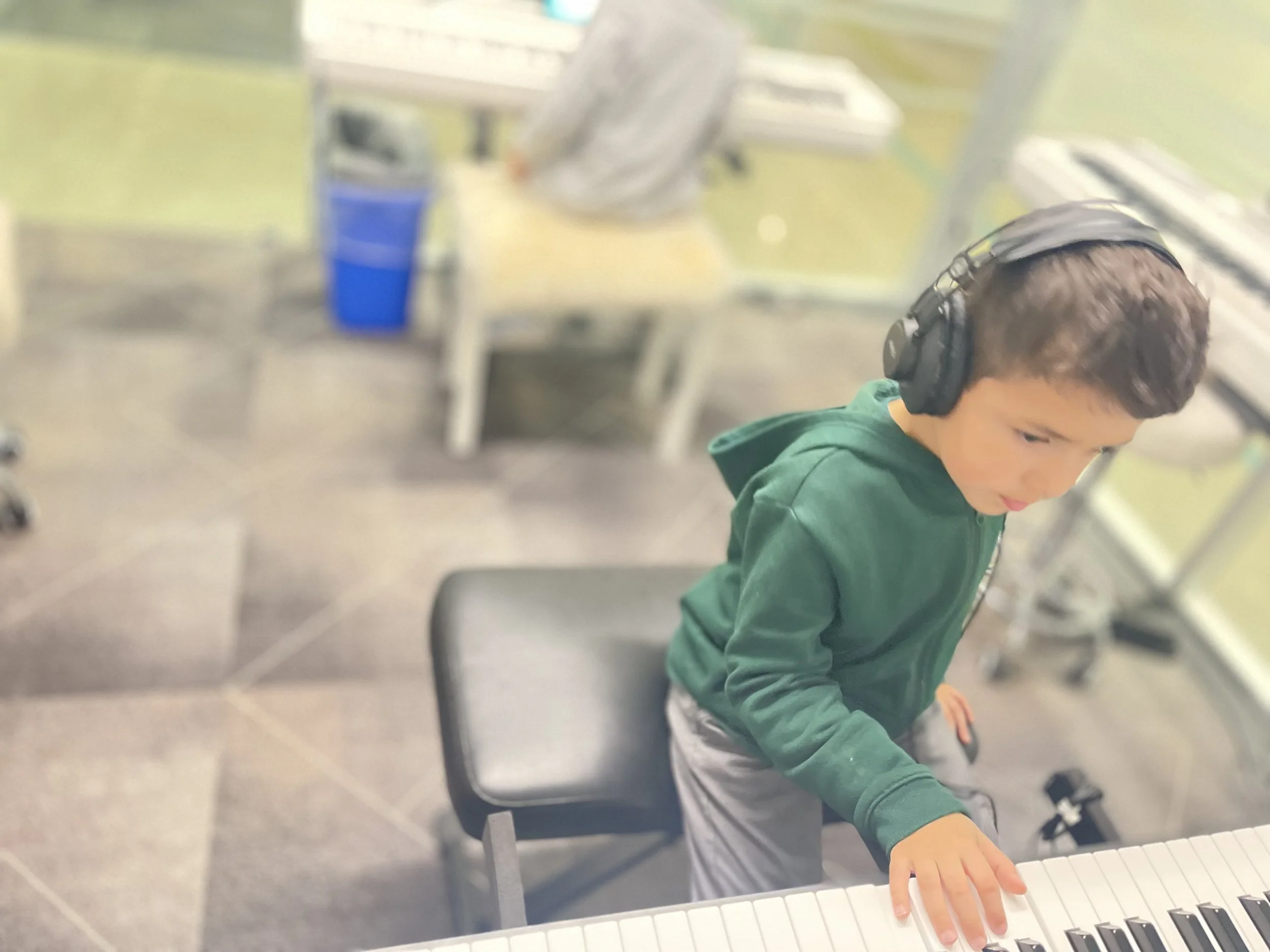
Semi-Private Piano Lessons Work So Well for Beginners
Why music lessons don’t fit neatly into “private” or “group”
When families start looking for piano lessons, they’re usually presented with two options:
private lessons or group classes.
Private lessons promise individual attention.
Group classes promise affordability and social energy.
But beginner pianists — both kids and adults — often need something in between.
That’s where semi-private piano lessons come in.
At our piano studio, semi-private lessons are not a fallback option. They’re the result of years of teaching beginners and noticing what actually helps students stick with music long term.
Why music is necessary — especially now
Music lessons are often treated like an extracurricular: something nice to have if there’s time, money, or a particularly talented child.
But music is more than enrichment.
Learning music teaches us how to:
pay attention without urgency
tolerate frustration and move through it
coordinate mind and body
listen deeply — to ourselves and to others
For children, music supports emotional regulation, confidence, and patience in a world that moves very fast.
For adults, it offers a rare space to slow down, focus, and do something physical and meaningful with their hands.
Music gives shape to time.
It creates order without rigidity.
It allows expression without requiring explanation.
That’s why how we teach matters.
When students learn music in a supportive, human environment — one that balances individual care with shared experience — the benefits extend far beyond the piano bench.
Semi-private lessons work not just because they’re efficient, but because they honor what music is actually for.
What are semi-private piano lessons?
Semi-private piano lessons typically include:
2–4 students per class
Individual instruments or keyboards
Personalized repertoire and pacing
Built-in listening, motivation, and accountability
Each student is learning their own music, but within a shared musical environment.
This structure allows for deep focus without isolation — something beginners benefit from more than most people realize.
Private lessons: wonderful, but not always ideal for beginners
Private lessons are powerful, especially for advanced students or those preparing for auditions.
But for beginners, they can sometimes feel:
intense
isolating
high-pressure
hard to sustain week after week
When a beginner struggles, there’s no peer context to normalize the experience. Everything happens under a microscope.
Some students thrive in that.
Many don’t.
Group piano classes: fun, but often too generalized
Group classes can be joyful and social, especially for very young children.
But they often require:
one pace for everyone
shared repertoire
less flexibility for different learning speeds
That can be frustrating for students who:
move faster than the group
need more repetition
learn best with individualized feedback
Why semi-private piano lessons strike the balance
Semi-private lessons combine the strengths of both formats.
They offer individual attention.
Each student receives direct feedback, technical guidance, and personalized musical goals.
They offer social motivation.
Students hear others play, notice improvement, and learn that progress looks different for everyone.
They build confidence.
Playing music around peers helps students feel less self-conscious and more resilient.
And they support consistency.
Students are more likely to show up, practice, and stay enrolled when they feel part of something.
For both children and adults, this balance is often the missing piece.
Semi-private piano lessons for kids
For children, semi-private lessons support:
listening skills
turn-taking
focus and regulation
confidence without performance pressure
Kids learn not only how to play the piano, but how to be musicians together.
They see that mistakes are normal.
They hear progress in real time.
They begin to say things like, “I’m getting better,” without needing to be told.
Many families come to us unsure about the right age to begin piano lessons and how readiness affects the learning experience.
In our experience, age five is often a strong starting point for semi-private piano lessons, when attention, coordination, and social learning begin to come together more consistently.
Semi-private piano lessons for adults
Adults often assume they should take private lessons.
But many adult beginners benefit from:
reduced pressure
shared experience
normalized frustration and progress
gentle accountability
Learning alongside others makes the process feel human, not evaluative.
Adults don’t need to be isolated to learn well — they need to feel safe, capable, and supported.
Why we teach this way
We didn’t choose semi-private lessons to scale faster or pack rooms.
We chose them because:
beginners learn better with both guidance and context
music is a social language
progress sticks when it’s witnessed and shared
Whether you’re enrolling a child or returning to the piano yourself, semi-private lessons offer a grounded, effective way to build real musical skills — without burnout or overwhelm.
Is semi-private right for everyone?
Not always.
Some students eventually transition to private instruction.
Some begin privately and move into semi-private settings.
The goal isn’t a format.
The goal is sustainable music-making.
Coming back to why music matters
Earlier, we talked about why music is necessary — not as an extracurricular, but as a way of learning how to pay attention, regulate emotion, and stay with something meaningful over time.
This is where semi-private lessons quietly shine.
They give students room to be seen and supported.
They allow progress without isolation.
They remind us that learning music doesn’t have to be lonely to be serious.
When students learn alongside others, music becomes what it has always been meant to be: a shared human practice, grounded in listening and care.
Curious whether this approach is right for you?
If you’re exploring piano lessons and looking for an experience that balances individual guidance with human connection, semi-private instruction may be a good fit.
We work with beginner children and adults who want to learn in a thoughtful, supportive environment — one that takes music seriously without making it heavy.
Whether you’re just starting out or returning to the piano after time away, there’s room to begin where you are.